
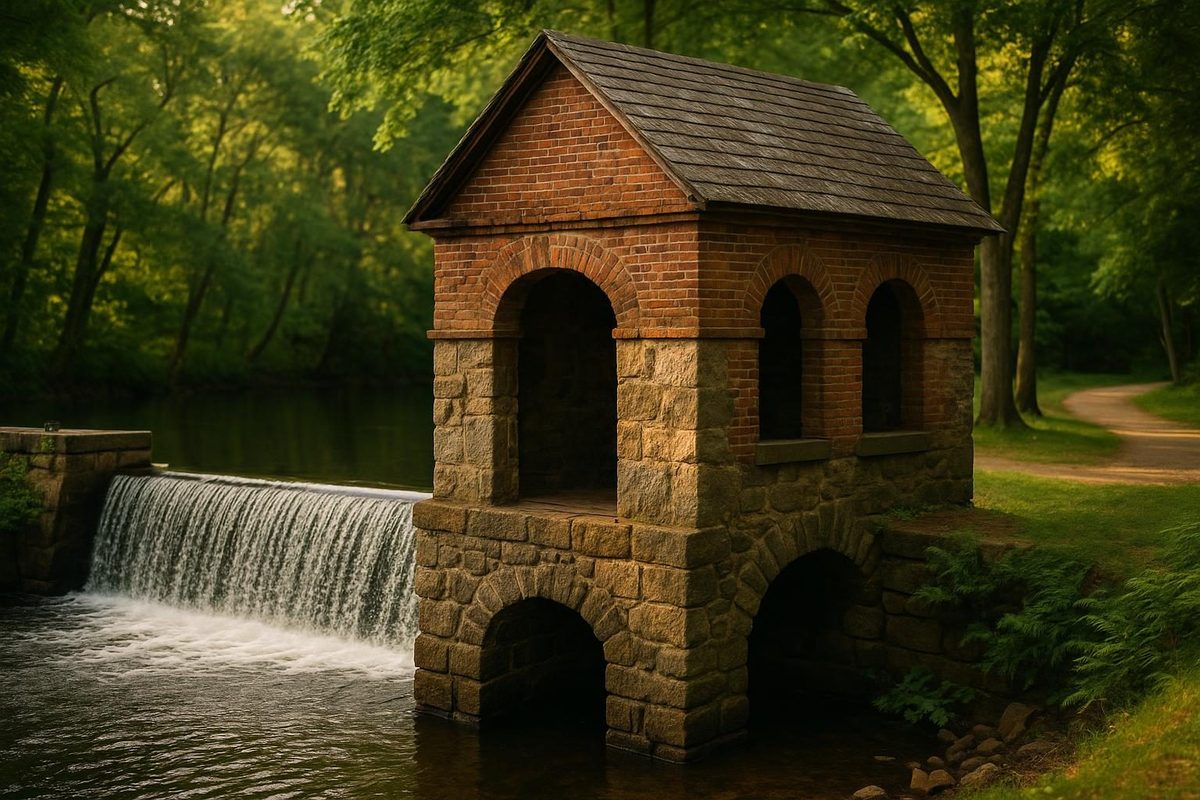
The Mine Falls Gatehouse is a brick dam gatehouse built in 1886 by the Nashua Manufacturing Company to control how much water left the Nashua River and entered the power canal feeding its textile mills three miles downstream. It sits inside the 325-acre park located in the heart of the city of Nashua, New Hampshire, and river water still passes through it on the way to the millpond.
How Water Traveled Three Miles to the Factories
Water reached the factories through a hand-dug channel, not the river itself. Guard gates at the intake diverted part of the Nashua River into the power canal, and by the end of its run that water moved fast enough to turn the waterwheels beneath the factory floors.
Why dig three miles? The answer is head, the vertical drop that gives falling water its force. The riverbed keeps descending toward downtown Nashua, while a man-made channel can be graded almost level. At the far end, the channel sits well above the river; the city puts that drop at 36 feet. The waterway delivered usable power right where the company wanted its buildings.
Crews dug that 3-mile long channel with shovels and mules in the 1820s, supervised by James Baldwin. The Merrimack Canal in Lowell, Massachusetts, about 10 miles downstream, had already shown investors what this kind of river could do.
Inside the Mine Falls Gatehouse: Five Lift Gates
The first gates at the intake went in around 1826. They were smaller and exposed, so for the replacement a Lowell contractor built five new lift gates enclosed by the brick walls that still stand.
A lift gate is a heavy panel raised or lowered in a slot to regulate water flow. Headgates like these are typically opened wider in low water and closed down in spring floods so the banks downstream do not overtop. The building was designed for practicality, not ornament, and its interior machinery reflects the shift from water power to electric power.
Timeline From the 1700s to Today
Key dates, mostly from City of Nashua records:
| Year | What happened |
|---|---|
| 1700s | Low quality lead was supposedly mined from the island below the falls |
| 1820s | Nashua Manufacturing Company chartered; dam built and power channel dug |
| 1826 | First gates built at the channel intake |
| 1886 | Brick gate building completed around five lift gates |
| 1948 | The company’s Nashua operation closes; owner Textron later sells the land |
| 1969 | City buys the land with city and federal Land and Water Conservation Fund (LWCF) money |
| 1980s | Small city-owned hydroelectric plant added near the intake |
| 1987 | Nashua River Canal and the mill district listed on the National Register of Historic Places |
| 1992 | Park trails designated part of the New Hampshire Heritage Trail |
What Was Actually Mined at Mine Falls?
Almost nothing. The name traces to the 1700s, when low quality lead was reportedly taken from an island below the rapids, but no mining industry followed. The origin of the city’s name follows a similar thread back to the river.
What visitors actually picture is the Mine Falls Dam beside the brick gate building. It raises the river enough to push water through the canal system to the millpond, and it, not any extraction, defined this stretch.
The Nashua Manufacturing Company and the Millyard
The Nashua Manufacturing Company was the cloth maker that built the intake, dug the channel, and ran the brick mill complex now called the Millyard. Steady flow in every season kept its looms running.
In the 1930s, many New England cloth makers moved south for cheaper labor. This firm stayed and shut down in 1948. Walking through the historic district today, you can still see brick walls and loading docks from that era. In 1987 the Nashua Manufacturing Company Historic District, with the dam and canal, was listed in the National Register, and the gate building counts as a contributing property.
Does the Gate Building Generate Electricity?
No. The brick structure only controls water. Electricity comes from a separate, small city-owned hydroelectric plant near the intake, dated to 1984 by the city (Wikipedia says 1986), rated at about three megawatts.
The original system produced mechanical power: wheels in the factory basements drove shafts and belts to the machines. On-site electricity arrived about 160 years after the first gates. Downtown’s cultural venues nearby tell a later chapter of the same city the canal helped build.
Visiting the Mine Falls Gatehouse Today
Mine Falls Park is open daily from 6 a.m. to 10 p.m., and the gate building stands at its western end off Stadium Drive. The grounds are bordered on the north by the Nashua River and on the south by the millpond, spanning both sides of the Everett Turnpike.
Entrances, Parking, and Trail Surfaces
The city’s map of the park shows entrances near Stellos Stadium, at Whipple Street, and at the Lincoln Park entrance off Exit 6, which tends to be the busiest. The Stadium Drive side is the closest parking area to the gates.
Surfaces range from packed dirt and tree roots to pavement and muddy stretches near the wetland. Flat terrain makes it a nice park for families, and the oxbow lake section is worth a detour, especially in late October foliage.
In 1992 the park trails were designated part of the New Hampshire Heritage Trail system, which extends 130 miles along the Merrimack River. Locally, there is enough space for an hour-long walk without doubling back.
Start on the Stadium Drive side so the Mine Falls Gatehouse is your first stop, then follow the water east toward the Millyard to see where its flow did its work. For a shorter outing, walk the millpond edge and loop back along the riverbank. For more local stories, browse the Nashua history archive.
Frequently Asked Questions
How many acres is Mine Falls Park?
The park covers approximately 325 acres of forest, wetland, and open space along the river in southern NH. The city purchased it in 1969 with city and federal Land and Water Conservation Fund money.
Is Mine Falls Park dog friendly?
Yes. Dogs are welcome on the trails but must be leashed. The packed dirt paths and flat terrain make it popular for dog walkers year-round.
How long is the main loop?
The most common loop around the canal and river is roughly 3 miles. Connecting paths let you extend or shorten the route.
Can visitors go inside the gate building?
Usually not. The park’s advisory committee has opened it for occasional public tours, including one covered by The Nashua Telegraph in June 2018.